Saturday, October 31, 2009

The Singularity


If your not following this... you probably have never seen it.
http://spacecollective.org/

Space collective is a commonwealth of digital transcendentalists looking for humanity's next step into the future, be it through outer space, cyber space, or spacetime: a group of the most intelligent and most imaginative on the web. Spacecollective asks the big questions of self, freedom, and intelligence. The content is made up of anything from philosophical arguments to design models of lunar housing.

Check it out; your evolution depends on it.

Wednesday, October 28, 2009

A Homeric Journey Through the Collective Conscious of Thoreau

From whatever afterlife meets us at our demise, Henry David Thoreau made clear his opinion of this blog to me today by way of organic vegetable vendors, Bjork, Larry King, and an impossibly hideous Chevrolet that I couldn't even find on the internet (thats how ugly) but could easily be substituted for such vehicles as the Lumina or the SSR Push. My journey began, as many do, upon an instance of stupidity; waking up from a long nap, I walked over to my bookshelf and imagined that I'd find Harry Stephen Keeler's The Riddle or the Traveling Skull waiting for me, but was hit by something blunt before I could get there: the realization that I did not, nor did I ever, own the book. Whatsthebigdeal? The Keeler book was assigned to me by Ed Park for his "Only Connect: Strategies for Writing" course. So, without much problem, I reserved the book at Barnes and Nobel in Union Square and walked downtown.
Why, you may be asking, would a professor ever assign a Harry Stephen Keeler novel? Isn't, you may be remembering, he the one who has been dubbed the worst mystery writer of all time? Wouldn't, you may be thinking, a writing professor assign a piece with substance and literary value? The answer: pending.
Did I just pick up and walk downtown right after reserving the book as I have said? No, not really. Anyone who has used the Barnes and Nobel book-pick-up-from-local-store system knows that it takes them an hour to send you a confirmation e-mail. So why do I say I reserved the book and started walking downtown? My meandering through the world wide web seemed irrelevant for most of my walk. I realized the importance of the Larry King debate between Anthony Bourdian and Jonathan Safran Foer in retrospect. They were debating the importance of meat in our diets. Jonathan Safran Foer's new book is called Eating Animals. Being one of my greatest literary heros, the announcement of this new book struck me as fuckingannoying, to say the least. Everything nutritionally biological in me sided with the chef, but the scene at Union Square, culminating in a paranormal connection between me and the late, great naturalist, shook my foundation.
You may be thinking, but what about that peta video I saw at my weed dealer's house or that chick grinding video or the effect of cattle production on the environment or the deadliness of e. coli or heart disease, and you are right, but did you ever take the livestock's intentions into consideration? What do these quasi conscious beings really want out of life? The answer, says Darwin, is to pass on their genetic makeup as far and wide as they can. Is it any mistake that meat cattle have evolved to fit our every need? Is it any mistake that we have wiped out practically every other species of cow on the planet to spread the genes of the ones that help us out for the things we want? Shake Shack Burgers? Our livestock have been outsmarting us into slaughtering them for food and, perhaps you're right, they need to be punished by shutting down factory farms and showing the livestock who's boss of this planet. (but seriously, can't we just keep on engineering? Couldn't we just adapt like we always do? Isn't that, like, our thing?)
Upon Union Square, Flying Lotus's mix of Bjork's 'All is Full Love' came on the ipod and I started getting that profound feeling that good music often puts on a person. This, Henry David Thoreau, was a dirty trick. Bjork is one of the most influential electronic artists of our time and should be out of your scope. There was construction going on in the park and, before I could realize, I was walking through a organic farmers market with all the staples of contemporary, anti-foodie banality: fresh fish vendors with long beards and long triton-like hair; fruit pushers with short, blonde dreads; zucchini peddlers with thick rimmed glasses, ponytails, and paint on their overalls. This is where the retrospective importance of the Larry King special hit me. This was kind of nice. This was the way farming was supposed to be: vegetables in the street. The song picks up and Bjork really starts to belt it out, "All is full of love, all is full of love, all is full of love," and I turn into the elevated area of the park to better orient myself and, like a scene from a disney princess movie circa 1969, squirrels, sparrows, larger unidentifiable birds and other (likely projected) woodland creatures came running out toward a woman with breadcrumbs.
"ALL IS FULL OF LOVE" (I'm trying to recreate this madness for you).
I picked up the book from Barnes and Noble and made my way home. I passed by the unnamed, hideous Chevy and thought, damn Henry, you got me. Maybe there's something to all this nature stuff that we keep fucking up.. Then I passed the United Cerebal Palsy of New York City building and thought, no, I've been right all along. I picked up some street meat on the same block and got back to my
apartment. My naturalist experience sat in my head like the eggplant on my lamb and rice. I didn't know what to do with it.
The first sentence of the Keeler book justified all my fears an arduously bad read:

I knew full well, when the Chinaman stopped me in the street that night and coolly asked me for a light for his cigarette, that a light for his cigarette was the last thing in the world he really wanted!

Isn't the nature of nature to die? Why was Thoreau haunting me with these images and feelings of transcendence (the bad kind). Thoreau and his ideas occupy the collective consciousness of our human world. That's his afterlife. That's all our chances at afterlife. Thoreau succeeded. He transcends his death. Our goals aren't too different. He called it spirituality; I call we call it a collective conscious. We have recently made amends. I just thought you should know.

Tuesday, October 27, 2009

Fantastic Planet and Jonas Burgert


Fantastic Planet is a french film from the 70's based on the Stefan Wul Novel, Oms en Série. It is a visual and conceptual journey about the power of knowledge. It is a thought provoking, psychedelic allegory that is as timely as it is aesthetically relevant. I would love to see this remade today.


(Watch the entire piece on youtube).

The images reminded me immediately of the Berlin artist, Jonas Burgert.


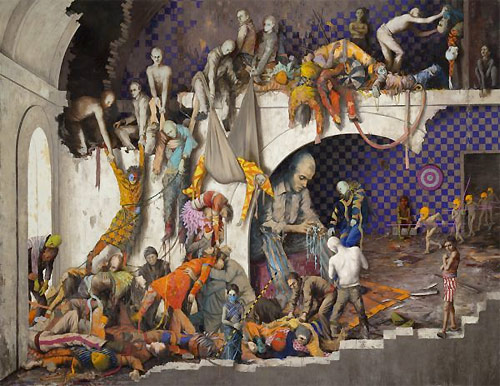
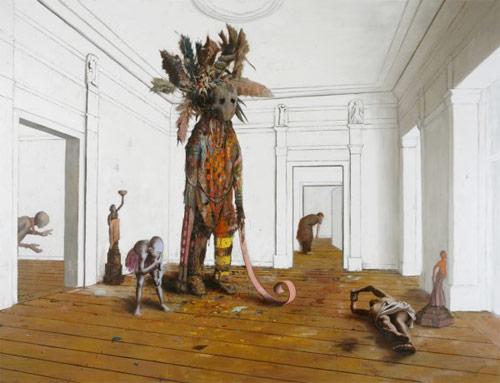
Burgert is likely one of the most talented painters around today. His work is mystifying, beautiful and inspiring (Fever Ray's 'If I Had a Heart' video?). His current show is "Hitting Every Head," at the Haunch of Venison in London. Maybe he could take a crack at the Fantastic Planet remake?

Seriously though; am I right?

Monday, October 26, 2009

Where the Wild Things Are, Freedom, Descartes and Kant

It is likely that anyone who has gone to see Where the Wild Things Are has had the similar revelation that at no point was Spike Jones interested in making a kids movie. There is something awe inspiring about this film that goes beyond the Urban Outfitters publicity, the bus ads, and the billboards. Where the Wild Things Are is a film that, like many before it, redefines our parameters for imagination.


Kant says this of our capacity for experience:

The I THINK must BE ABLE to accompany all my representations; for otherwise something would be represented in me that could not be thought at all, which is as much as to say that the representation would either be impossible or else at least would be nothing for me.
-Immanuel Kant, The Critique of Pure Reason

As I looked over this today, I found something curious about his suggestion. If it were so that the I think (concepts) did not accompany a representation, we would not experience it. Could it be that some things exist in the world that we cannot see or experience because they do not fit our concepts of the world? This reminded me of Descartes and his famous argument for skepticism. Descartes had dreams, he claimed, that felt as though they could be real and of his waking life. This, therefore, meant that he could not be certain whether he was dreaming or not... ever. But did Descartes have dreams that were as surreal as some of ours tend to be now, in light of such perceptual stimuli as Where the Wild Thins Are and its visually stimulating predecessors? Could he have?

The realism of this film makes me believe that Descartes could not have had the imagination I have, or any of us have. A film like Where the Wild Things Are allows us to conceptualize the impossible. Our experience is able to lay outside the confines of the laws of nature. Our deterministic loop is synthesized with something Descartes or Kant could have never imaged. The predictions we make and, in turn, the decisions we make are constituent upon more than our experience of the natural world. In this way, even our freedom exceeds that of people existing just a few hundred years ago. Where our memories and experiences inform our patterns and predictions, a plane of meta-experience (experience beyond that of the natural world) affords us an avenue of freedom never experienced before.

As film production technology advances, and the experiences we are able to cognize expand, the things that make us conscious humans change. Was this Spike Jones's plan all along? Probably not, but it is the nature of art to expand our consciousness in whatever way it can. This film, to me, was a life-altering step in the right direction. If for no other reason than that, Where the Wild Things Are is one of the most important films of our time.

Saturday, October 24, 2009

Nature After 'After Nature'

Maybe there's some kind of evolutionary cause, or some kind of genetic tick –- or side effect –-, but the human desire to recreate the complex, unintentional patterns of nature is astounding.


Tara Donovan
is a brooklyn based artist who works with staples of human design, i.e. pencils, drinking straws, styrofoam cups, assembling natural landscapes that invoke images bacteria beneath a microscope or a mossy field.


Non-format'sinnovative "Peroxide" campaign is just one of the many digital invocations of nature. Combining photography and digital images, the result is a kind of interstellar milkshake: the natural kind.


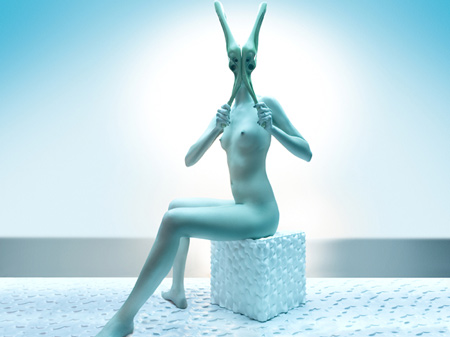
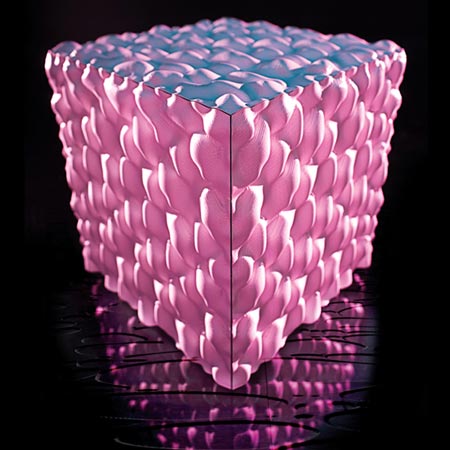
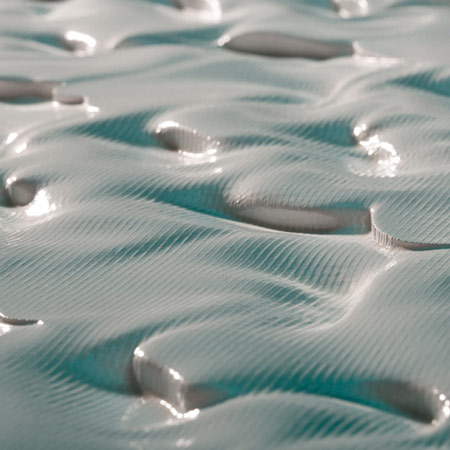
Likely the purest and most digitally transcendental example of the manifestation of nature in digital art is that of Commonwealth Design Studio. With their lard series, Commonwealth not only captures the idiosyncrasies of nature in a digital schematic, but were able to reproduce these beautiful pieces in the physical world.

http://www.commonwealth.nu/projects/61/lard

These brooklyn based designers reek of innovation. Their work is both beautiful and inspiring in way that convinces me I am living in an age where Rembrandt is a furniture designer.

If their work looks familiar, you may recognize the masks from Timothy Saccenti's show, The Garden of Unearthly delights (just a few posts down).

Thursday, October 22, 2009

Tauba Auerbach

Besides the obvious aesthetic beauty that Auerbach produces in her captivatingly deadpan works, what makes her so mystifyingly fascinating? I am reminded of Rainer Maria Rilke and his invention of the 'thing-poem.' He, working closely under the influence of Rodan, thought that a poet could produce a poem that was a kind of thing that you could hold and examine. Auerbach turns that on its head by reaching into our most geometrical constructs for perception and pulling out... things.


Her art, like that of Rilke's, is a move from the metaphysical to the physical. Her paintings, sculptures, prints and photographs all embody the a priori places in us that lack a place in our material world. Her work on the digital world is the same. Auerbach takes the intangible world of waves and distortions and captures them in a way that demands contemplation.


here

Wednesday, October 21, 2009

Sayonara Film

Was it Jean Cocteau who said that film would never be an art form until it was as cheap as paint and brushes? The day is steadily approaching. Deal with the results America!

http://ubu.com/film/trecartin_kcorea.html

This is the work of artist Ryan Trecatrin. If your terrified, don't be terrified; its terrifying and is meant to be. Being one of the more ugly things I've seen, there is something hypnotizing about it. The process of watching says as much about what make us a society as the content.

http://ubu.com/film/trecartin_sibling.html

This piece is in the same vein but longer and slightly more narrative. Give it a chance. By the end, you sort of feel like you've been punched in the face... in a good way. and don't forget, as the great Diderot said, "There's no one who doesn't put the existing order on trial, without noticing he's renouncing his own existence."

Apologies for the links